Dodge Charger RT Vs. Charger Daytona Comparison
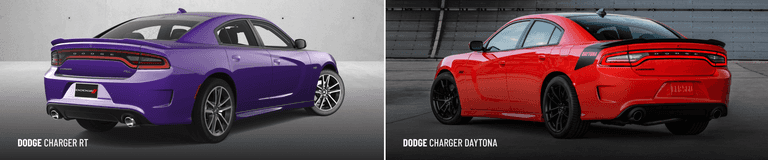
The Dodge Charger RT vs. Charger Daytona comparison is a battle between the
outgoing glory of the proper American V-8 and the incoming innovation of
all-electric muscle. The end of the HEMI-powered Charger is upon us, but
there's no need to be sad. Its replacement, the Charger Daytona SRT EV, joins
the world of electric cars and makes it meaner. Thanks to its Fratzonic
Chambered Exhaust (the first-ever EV exhaust system) and packages that
simulate the fun of old-school muscle car tuning, the Charger Daytona EV is
the opportunity to go electric that American performance enthusiasts have been
waiting for.
If you've been waiting for a deal on one of the last American muscle cars with
a HEMI V-8, you're in luck, too. The final Charger RT models are waiting for
you on our lot, as is the opportunity to register your interest in the
upcoming Charger Daytona EV. Consult our Dodge Charger RT vs. Charger Daytona
comparison guide below to see whether a futuristic EV or a future classic is
right for you, then make your move at San Antonio CDJR.
Dodge Charger RT vs. Dodge Charger Daytona Specs
Dodge Charger Daytona vs. RT power specs, using current estimates from the
brand, are a win for the EV. That shouldn't be too shocking, though, as
it's already been established that electric powertrains can make more power
and accelerate faster than their gas alternatives. The rumble of a proper
gas-fed V-8 and its roar as you blast through the gears is a major benefit,
though.
Offering drivers powerful acceleration and the legendary experience of a HEMI
V-8 at a great price, the Dodge Charger RT serves as a great entry point to
the V-8 Charger lineup. It boasts a 5.7-liter HEMI V-8 engine with 370
horsepower and 395 pound-feet of torque under its hood. Rear-wheel drive and
an eight-speed automatic transmission form the rest of the Charger RT sedan's
powertrain.
The Dodge Charger Daytona vs. Charger RT specs comparison is not a complete
reflection of production models as of our writing, since the Charger Daytona
EV is still in its pre-production phase. Regardless, the Dodge brand has
stated that all Charger Daytona EV models will be AWD, and the base-level
400-volt configuration (Charger Daytona 340) will make 455 horsepower. Two
eStage kits will be available for power upgrades, simulating old-school tuning
work. Adding the eStage 1 kit brings the base model to 495 horsepower, while
the eStage 2 kit takes it to 535 horsepower.
The Dodge Charger RT vs. Charger Daytona comparison is already a win for the
upcoming Charger Daytona, and in its enhanced 400-volt Charger Daytona 440
model, it pulls even farther ahead with its 590 horsepower output. The eStage
1 kit will let it make 630 horsepower, while the eStage 2 kit will bring it to
670 horsepower.
Only two of the current
Dodge Charger trims can exceed this
potential power: the 717-horsepower Charger SRT Hellcat and the 797-horsepower
SRT Hellcat Redeye. However, a Dodge Charger Daytona EV model with an 800-volt
Banshee propulsion system will join the lineup, and while its horsepower is
unconfirmed, doubling the voltage can only result in more power.
|
|
Dodge Charger RT
|
Dodge Charger Daytona EV
|
|
Engine:
|
5.7L HEMI V-8
|
- 400V 340 kw Electric Architecture (Base Model)
- 400V 440 kw
Electric Architecture
- 800V Banshee Electric Architecture
|
|
Horsepower:
|
370
|
- 455 to 535 (400V 340 kw Model)
- 590 to 670 (400V 440 kw
Model)
- Unconfirmed (800V Banshee Model)
|
|
Torque:
|
395 lb-ft
|
To Be Announced
|
|
Transmission:
|
8-Speed Automatic
|
eRupt Multispeed Transmission w/ Electro-Mechanical Shifting
|
|
Drivetrain:
|
RWD
|
AWD
|
|
0-60 mph:
|
5 Seconds1
|
- To Be Announced (400V 340 kw & 400V 440 kw Models)
- "Faster
than a Hellcat in all key performance measures"2 (800V
Banshee Model)
|
|
Availability:
|
Discontinued - 2023 Was Final Model Year
|
Upcoming - Anticipated For 2025 Model Year
|
Dodge Charger RT vs. Dodge Charger Daytona 0-60 Time
Using its powerful V-8 engine, the Dodge Charger RT can accelerate from 0 to
60 mph in just five seconds.1 We don't have accurate Dodge Charger
RT vs. Daytona EV 0-60 stats yet because the Daytona EV model's acceleration
has not been measured as of the time of writing. That said, an EV's instant
torque almost always achieves faster 0-60 mph times (especially with AWD) than
similarly powerful gasoline cars, and the Charger Daytona EV model's higher
horsepower already hints at it being faster.
That's especially true of the 800-volt Banshee model – the brand has
officially stated that it will be "faster than a Hellcat in all key
performance measures."2
Dodge Charger RT vs. Dodge Charger Daytona Performance Features
While a full look will have to wait until the official debut, we've seen
several innovative performance features that will let the Charger Daytona EV
simulate the thrills of our gas-powered
new Dodge Charger inventory.
For starters, many first-time EV drivers are put off by the lack of gear
shifts while getting up to speed. The Dodge Charger RT vs. Charger Daytona
shifting feel will be similar, as the Charger Daytona introduces an exclusive
eRupt multispeed EV transmission with electric-mechanical shifting. The
addition of gears to an EV can enhance performance, range, and driver
engagement on the road.
Many drivers favor the gas model in the Dodge Charger RT vs. Charger Daytona
comparison because, well, it makes noise. We don't blame them – we can't get
that iconic V-8 soundtrack out of our heads, either. However, the Charger
Daytona EV solves what many find lacking in electric cars: auditory feedback
as you put down power.
This will be done with a Fratzonic Chambered Exhaust that can scream as loud
as 126 decibels (same as a Charger Hellcat). When you combine this with the
multispeed transmission's feedback, you'll get a driving experience that feels
like the future of real cars rather than an isolated vision that
doesn't consider the century-long love humans have had for gas-powered cars.
Get One of the Final Dodge Charger RT Models Today
The Charger Daytona EV is scheduled to join the
all-new Dodge inventory at San Antonio CDJR
later this year. In the meantime, you can still get your hands on the Charger
RT, one of the last Charger models with a HEMI V-8. Ask about our lease deals,
and visit us to test-drive the final chapter of V-8 muscle.
Frequently Asked Questions
What does "Daytona" mean on a Charger?
"Daytona" has meant several things to Charger throughout history. First, it
was the name of the winged monster that shook up the 1970 NASCAR season. Next,
it was a package that could be applied to modern Dodge Charger models to
enhance their power and aerodynamics. Today, the new Dodge Charger Daytona is
a soon-to-be-released all-electric muscle car. Stay tuned for the latest
Charger Daytona.
Is the Dodge Charger RT or Daytona faster?
The Charger RT is a fast car that makes 370 horsepower, but the upcoming
Charger Daytona EV is set to be even faster, since its weakest form should
arrive with 455 horsepower. Making an estimated maximum of 670 horsepower and
laying it down with instant fury, if the Charger Daytona isn't faster
than the Charger RT, we'll be surprised. The Charger Hellcat may still be
faster, though.
What is the 0-60 mph time of the Dodge Charger Daytona?
The 0-60 mph time of the upcoming Dodge Charger Daytona EV has not been
measured yet, but the model's power output is an estimated maximum of 670
horsepower. As the 370-horsepower Dodge Charger RT goes from 0 to 60 mph in
five seconds,1 we'd be shocked if the higher horsepower and
instant torque delivery of the Charger Daytona result in a slower 0-60 mph
time.
Our Featured Review Of The Dodge Charger
Thank you to Julio and the San Antonio Dodge dealership for helping me
find my new 2022 Hemi Dodge Charger. The staff was nice and kept me
informed. This process was a lot smoother than expected. I definitely
recommend this hidden dealership.